

20 May Cargo Services from Pakistan: The Complete 2026 Guide to Shipping Worldwide
Walk into any cargo office in Karachi on a Monday morning and you’ll see the same thing. Stacks of boxes labeled for Manchester, Toronto, Houston, Sydney. Families packing up a lifetime into wooden crates. Business owners wrapping samples for buyers in Birmingham. The volume of cargo leaving Pakistan has grown sharply over the past five years, and most of it heads to four destinations. The UK, USA, Canada, and Australia.
This guide is for anyone planning to send cargo from Pakistan overseas. Whether you’re a Pakistani living abroad shipping a relative’s belongings, a small exporter sending samples, an Amazon seller dispatching FBA stock, or a family relocating permanently. We’ll cover what services exist, how pricing actually works, what documents you need, and how to avoid the mistakes that delay 4 out of 5 first-time shipments.
By the end you’ll know which service fits your situation, what realistic costs look like in 2026, and what to ask any freight forwarder before handing over your goods. Let’s start with how the cargo industry in Pakistan actually works.
The Cargo Industry in Pakistan: A Quick Background
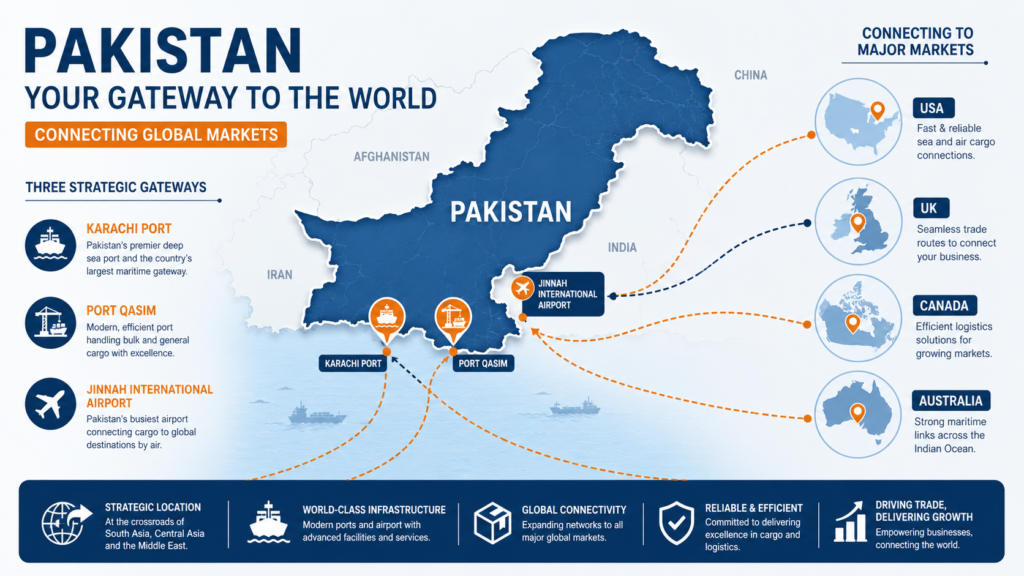
Pakistan’s international cargo sector runs through three main gateways. Karachi Port and Port Qasim handle the bulk of sea freight. Jinnah International Airport in Karachi handles most air cargo, with Lahore and Islamabad airports playing a smaller but growing role. Almost every international freight forwarder in the country has a base in Karachi for one reason. That’s where the ships are.

The industry serves two very different audiences. Commercial exporters moving textiles, surgical instruments, leather goods, rice, and sports equipment to buyers worldwide. And the diaspora market, which is Pakistanis abroad sending or receiving personal effects, gifts, household goods, and small business inventory. Both streams use similar infrastructure but need very different handling.
Customs in Pakistan moves through the Pakistan Single Window (PSW) system, the country’s national digital portal for trade documentation. On the destination side, your cargo passes through HMRC in the UK, CBP in the USA, CBSA in Canada, or Australian Border Force. Each has its own rules, and that’s where most shipments get stuck if paperwork isn’t tight.
Types of Cargo Services Available from Pakistan
There are four main service types, and picking the wrong one costs you either money or time. Sometimes both.
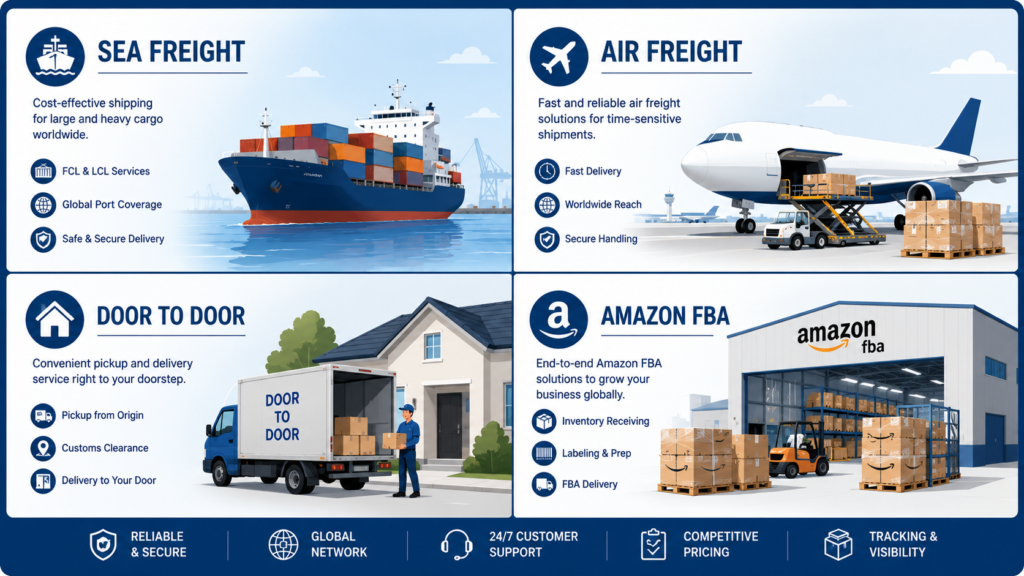
Sea Freight is the workhorse for large or heavy shipments. Goods travel in containers from Karachi Port to the destination port, usually taking 25 to 45 days depending on route. You can ship a full container (FCL) if you have enough volume, or share container space (LCL) if your cargo is under 13 to 15 cubic meters. Sea freight wins on cost. It loses on speed.
Air Freight moves cargo in days, not weeks. From Karachi to London, expect 3 to 5 days door-to-door. To New York, around 5 to 7 days. The catch is price. Air rates run 4 to 8 times higher per kilogram than sea, which makes it suitable only for urgent shipments, light high-value items, or perishable goods.
By Sea Door-to-Door Delivery (DDP) is the most popular option for personal cargo. It bundles everything. Pickup from your address in Pakistan, ocean freight, destination customs clearance, duty payment, and delivery to the receiver’s door. You pay one price and forget about paperwork. This is what Pakistani families overseas use most. We cover this service in depth on our by sea door delivery page.
Amazon FBA Shipments are a fast-growing niche. Pakistani sellers shipping inventory directly to Amazon warehouses in the US, UK, or Canada need specialized handling. Pallet preparation, FBA labeling, appointment booking at fulfillment centers. It’s freight forwarding with a layer of e-commerce compliance on top.
Most first-time shippers don’t realize how different these services are in practice. If you’re trying to figure out which freight forwarder fits your needs, our guide to choosing a cargo company in Karachi breaks down what to look for.
How to Choose the Right Service for Your Cargo
The decision comes down to three questions. How much are you shipping? How fast do you need it there? What’s your budget?
For personal effects and household goods under 5 CBM, by sea door-to-door is almost always the right answer. The per-kilogram cost is low, your goods arrive at the receiver’s door, and you don’t deal with destination customs yourself. Commercial sellers with regular inventory flow should look at LCL or FCL ocean freight, since they can handle their own destination clearance and save on the door-delivery premium.
Air freight makes sense for three scenarios. Urgent business documents and samples. Time-sensitive personal items. And small high-value parcels under 30 kilograms where the speed premium is worth it. For anything bulky and non-urgent, air is a waste.
Container choice matters too. A 20-foot container fits roughly 28 to 33 CBM of cargo. A 40-foot container holds about 56 to 67 CBM. If you’re filling less than half a 20-foot, LCL is cheaper. The crossover point sits around 13 to 15 CBM, where FCL starts winning on per-CBM cost. We’ve explained this trade-off in our LCL vs FCL guide.
One thing most buyers get wrong: comparing rates without checking what’s included. A “cheap” quote that excludes destination customs charges, terminal handling fees, and last-mile delivery isn’t cheap. It’s incomplete. Always ask for an all-in DDP price for personal cargo, and demand a written breakdown for commercial shipments.
Major Destinations: USA, UK, Canada, Australia
These four countries account for over 80% of personal cargo leaving Pakistan, and each has its own quirks.
Pakistan to the USA typically runs 30 to 45 days by sea, depending on whether your cargo lands at Los Angeles, New York, or Houston. Customs is handled by CBP, and you’ll need ISF 10+2 filing for ocean shipments. Common items shipped include household furniture, clothing, kitchen goods, and Amazon FBA inventory. The US has the strictest restricted-items list of the four, so check before you pack.
Pakistan to the UK is the busiest route. Sea freight runs 25 to 35 days to ports like Felixstowe or Southampton. UK customs goes through HMRC, and personal effects benefit from Transfer of Residence relief if you’re relocating permanently. We’ve put together a complete walkthrough in our Pakistan to UK shipping guide.
Pakistan to Canada takes 35 to 50 days by sea. Most cargo arrives at Montreal or Vancouver. CBSA handles customs, and Canada is generally less strict than the US on personal effects, but stricter on food items and wood packaging. ISPM-15 certified wooden crates are mandatory.
Pakistan to Australia has the longest transit, often 30 to 45 days to Sydney or Melbourne. The Australian Border Force runs the tightest biosecurity check of any major destination. Anything with traces of organic material, soil, seeds, or untreated wood gets flagged. A pack like an inspector will open every box, because they often do.
Documents You Need to Ship from Pakistan
Paperwork kills more shipments than anything else. The good news is the list isn’t long. The bad news is missing one item delays your cargo by 7 to 14 days.
You need a copy of your CNIC or passport. A commercial invoice showing each item and its value. A packing list with item counts and weights. The receiver’s full address, phone, and ID number at destination. And a signed letter of authorization if a freight forwarder is clearing customs on your behalf.
For commercial cargo add a Bill of Lading (B/L) issued by the carrier, the correct HS Code for each product, and any country-specific certificates. Textiles to the US need a Wearing Apparel Detail Sheet. Food items need health certificates. Electronics need declarations of contents.
The most common mistake we see? Undervaluing the cargo on the invoice to dodge duty. Customs in all four destination countries flag this immediately. Your shipment then sits in a bond warehouse while you pay both the original duty and a penalty. Honest declarations save money in the long run. Our full documents checklist covers every form needed for each destination, with examples.
How Cargo Pricing Actually Works
Sea freight is priced by volume (CBM) or weight, whichever is higher. For most household goods, volume wins. Typical 2026 ranges for by-sea door-to-door from Karachi:
- To UK: around 280 to 380 USD per CBM, all-in DDP
- To USA: roughly 350 to 480 USD per CBM, depending on city
- To Canada: about 380 to 520 USD per CBM
- To Australia: in the range of 400 to 550 USD per CBM
Air freight is priced per kilogram, with a minimum chargeable weight calculated as either actual weight or volumetric weight (length x width x height in cm, divided by 6000), whichever is higher. Expect 5 to 9 USD per kg to most major destinations for general cargo, more for express service. For lane-specific rates and current market conditions, you can also cross-check estimates against industry sources like Drewry’s World Container Index, which publishes weekly container shipping rates.
Hidden costs that catch people off guard: documentation fees, port handling charges, duty on goods exceeding personal allowance thresholds, fumigation for wooden items, and storage if your cargo sits at destination port waiting for customs. Always ask whether a quote includes these.
For buyers weighing the cost of door-to-door against arranging things themselves, we wrote about this trade-off in is door to door cargo worth it.
How Pakistan Cargo Compares to Direct Couriers Like DHL or FedEx
A question we hear constantly: “Why not just use DHL?”
Fair question. For small parcels under 5 kg, especially documents and urgent samples, DHL or FedEx is genuinely faster and often simpler. You pay a premium, but the door-to-door timeline of 3 to 5 days beats anything in cargo.
The math changes fast above 10 kg. A 30 kg shipment from Karachi to London by DHL Express runs around 350 to 450 USD. The same 30 kg as part of an LCL sea consolidation runs roughly 80 to 120 USD all-in. For 100 kg the gap widens further. DHL might quote 1,200 USD. Sea LCL door-to-door is around 250 to 350 USD.
There’s also a customs angle. Couriers ship under their own bulk customs clearance, which is fast but limits what you can declare and how. Cargo via a freight forwarder lets you ship household goods, used personal effects, and bulkier items that couriers either reject or surcharge heavily. If you’re moving a family’s worth of belongings, no courier will touch it. You need cargo.
The honest answer: use a courier for small urgent stuff, use cargo for everything else. The break-even point is around 15 to 20 kg.
Common Questions Buyers Ask
How long will my shipment actually take door to door? Sea freight door-to-door from Pakistan ranges from 35 to 60 days in total, including pickup, transit, customs clearance at destination, and last-mile delivery. Quotes often only show transit time, which is misleading. Always ask for a total door-to-door estimate.
Can I track my cargo while it’s in transit? Yes. Reputable forwarders provide a tracking number once your cargo is loaded. Sea shipments update at major checkpoints: loaded at origin, departed port, arrived destination port, cleared customs, out for delivery. Daily live tracking isn’t realistic for ocean freight, but weekly updates are standard.
What happens if my goods are damaged in transit? Standard freight liability is limited by international conventions, usually a small amount per kilogram. For valuable goods, ask about cargo insurance. It typically costs 0.5 to 1% of declared value and covers full replacement.
Can I send used household goods, or only new items? Both are allowed. Used personal effects often qualify for reduced or zero duty if you’re relocating permanently and can prove residency change. New goods are treated as imports and attract full duty unless under personal allowance limits.
Is it safe to pay before goods are picked up? Established forwarders take a deposit at booking and balance at pickup or pre-departure. Avoid anyone demanding 100% upfront before they’ve even seen your cargo. That’s a red flag in this industry.
Who This Guide Is NOT For
Some honesty matters here. If you need same-day or next-day delivery anywhere overseas, cargo isn’t your answer. Use DHL, FedEx, or UPS Express. Cargo timelines start at 3 days minimum for air, and the ocean takes weeks.
If you’re shipping under 5 kilograms total, you’ll usually pay less through a courier than a cargo company. Forwarders have minimum charges, and small parcels don’t benefit from cargo’s economies of scale.
If your goods need temperature control, hazmat handling, or live animal transport, general cargo services don’t cover this. You’ll need specialized providers with the right certifications. Pharmaceuticals, lithium batteries above certain thresholds, and perishables fall into this category.
And if you’re not willing to provide accurate documentation, please don’t ship. Customs authorities catch undervaluation, false declarations, and prohibited items routinely. The penalties cost more than the duty you tried to avoid.
Where to Go From Here
Cargo from Pakistan isn’t complicated once you understand which service matches your situation. Big personal shipments and household goods go by sea door-to-door. Urgent or light parcels go by air. Commercial regular flow uses LCL or FCL. Documents and small urgent items go via courier.
If you’re shipping personal effects to family abroad, start with our by sea door delivery guide. If you’re trying to pick a forwarder you can trust, read our breakdown of what makes a good cargo company in Karachi. And if cost is your main worry, the sea vs air freight comparison will help you avoid overpaying.
Got a specific shipment in mind? Request a free quote from Xcore Freight and we’ll give you a realistic all-in price within 24 hours, with no hidden charges in the small print.
No Comments